Arthur Cyril Heyes
The most exciting time in Arch's life was his war service. He served in both of the World Wars; in the trenches with the Lancashire Fusiliers, in the air with the Royal Flying Corps and later with the Royal Air Force. By the time he was finally discharged he had attained the rank of Wing Commander; equivalent to the Army rank of Lieutenant Colonel.
Arch was born in 1896, the youngest of seven surviving children of Yates and Mary Heyes of Salford, Lancashire. Arch's eldest brother, Landor, was some 25 years his senior. Their circumstances were modest. Arch had a lifelong fondness for his sister Grace who, as teenager, toured the South of England as part of an itinerant roller-skating troop. When performing near Falmouth, Grace was spotted by the Cookson brothers, Roger and Hugh. By all accounts Grace was very beautiful and the Cooksons were very rich! Hugh Cookson, a member of the landed gentry married Grace Heyes, a lass from Lancashire in 1917. Arch and older sister Aida were witnesses to the wedding. The Cookson connection was to transform the Heyes family life style.
At the outbreak of the War in 1914, Arch, then aged 18 volunteered for Army service. He enlisted on 7th. October, 1914 in Cross Lane, Salford and joined the 8th. Lancashire Fusiliers . On 31st. May 1915 he was promoted to Acting Lance Corporal, and one month later to Acting Corporal. However, on 22nd. July 1916 he was reduced to the ranks on the orders of his Commanding Officer; his war record gives no explanation! One week later, 1st. August 1916, he was posted to France.
A change of posting to the 16th. Lancashire Fusiliers (7/9/1916) saw him regain his rank of Acting Lance Corporal (10/12/1916). I am still trying to work out just where Arch saw action. I am not sure where he was prior to 1916 but he was with the Lancashire Fusilers during the Battle of the Somme. This included the battles of Arras, Albert, Bapaune, Ancre (Nov. 1916). I think he was at Paschendale (Oct 1916) and Beaumont Hamel but I have yet to work out the correct order of things.
Arch applied for a transfer to the Officer Cadet Corp at Brookham from where on 30th June 1917 he obtained a commission in the Royal Fusiliers. (Ref: London Gazette 20/6/1917). On the 17th June, while on leave, he was a witness at the wedding of his sister Grace and Hugh Cookson in Blackpool.
On 24th. July 1917 Arch was back in France. I recall Arch telling me that
he considered life in the trenches to be far too hazardous. Most of his comrades -including the men either side of him in this photograph - were, by this time, either seriously wounded or dead. Arch resolved to make a move. After a year with the Royal Fusiliers he achieved his ambition by transferring (23/6/1918) to the Royal Flying Corps - (RFC), Actually Arch joined a branch of the RFC which was known as Maj General Sir Hugh Trenchard's 'Independent Force'. A somewhat maverick organisation given the dangerous duty of carrying the air war over the frontiers of Germany proper. Later these various units were absorbed into the Royal Air Force. In September 1918 Arch was flying with 55 Squadron based at Azelot, a village a few miles south of Nancy in North East France. He was an Observer and held the rank of 2nd. Lieutenant. (The equivalent RAF rank is Pilot Officer but the RAF did not have its own ranks until 1919). It would seem from the vivid descriptions given by W.E.Johns that 'Observer' was something of a euphemism for 'Rear Gunner'.
55 Squadron (motto: Nil Nos Tremefacit - Nothing Shakes Us) was a bomber squadron and the first to fly the new DH4s designed in 1916 by Geoffrey de Havilland.
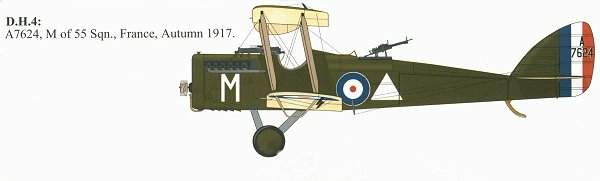
Looking at the photograph it would seem that the motto was particularly apt. Although primarily used as bombers the DH4 was also used by 55 Squadron for photo reconnaissance. Arch was soon to discover that life with the RFC was hardly less hazardous than life in the trenches.Arch was destined to fly on only two bombing raids. On the first he failed to return. The pilot, George P Dymond , overshot Azelot in thick cloud and made a forced landing near Neufchateau. On his second mission, 25th. September 1918, Arch, with a different pilot, 2nd.Lt. George Burn Dunlop, again failed to return; this time both men were listed as 'Missing In Action'.
A worrying cutting from the Eccles and Patricroft Journal!
In a letter dated 11th. October 1918 from the Red Cross the family learned that Arch had been shot down - no parachutes in those days - and taken prisoner. Arch's Casualty Card tells only part of the story.
Drawing on information from both the British and the German side one is able to build up a detailed picture of events. Firstly, the official British Bombing Raid Reports for the two sorties give lots of interesting detail....
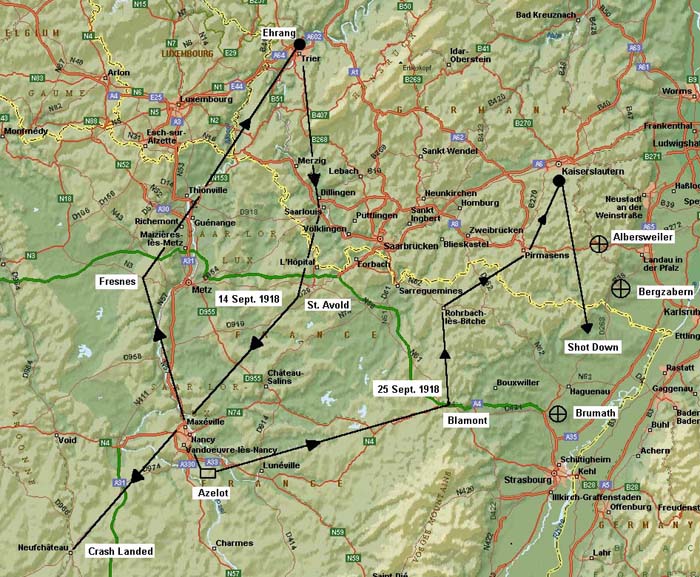
14th. September 1918: Raid on railway junction at EHRANGE.
12 DH4s 11 of which reached the objective.
Anti-Aircraft fire: Poor. No Enemy Aircraft seen.
Squadron Commander's remarks:
Crossed lines over FRESNES at 15,500 feet and proceeded straight to EHRANGE, which was bombed with good results. The return journey was done over SAARLOUIS, ST. AVOLD and DELME. Considerable railway activity on railways round LUXEMBOURG and TREVES (now Trier). Very cloudy across the lines.Casualties: Pilot Dymond and Observer Heyes failed to return. Reported to have left the formation on the return flight shortly before crossing the line. Last seen heading for TOUL.
They were later found to have forced landed at NEUFCHATEAU.Note: Of considerable interest is that 2nd. Lieutenant W.E.Johns flew on this sortie. Two days afterwards Johns himself was shot down while on a raid over Mannheim. After being taken prisoner he escaped only to be recaptured and sentenced to death. The end of the war came just in time to save him. He added Captain to his name and went on to write the famous Biggles books.
I have been fortunate to find, and to have been granted permission to reproduce, two accounts of the goings on at 55 Squadron, one written by Johns himself, the other written about John's time in the 55. If you think my account of my father's exploits is interesting you will find these accounts fascinating.
25th. September 1918: Raid on munitions factory S. of
KAISERSLAUTERN.12 DH4s All reached the objective.
Anti-Aircraft fire: Heavy and accurate over objective.
Enemy Aircraft: About 25 - 30 on return journey.Squadron Commander's remarks:
Lines were crossed at 14,500 feet at BLAMONT and a course was steered over BITSCHE and PIRMASENS to KAISERSLAUTERN.
Returned over SAARBURG to LUNEVILLE.
Weather conditions good, strong W.S.W. wind.
On the outward journey no E.A. were encountered, but after leaving objective at least 12 attacked, these were partly driven off but were heavily reinforced and a stiff fight ensued to the lines.
Two E.A. were destroyed, one by Lt.W.G.Braid (Pilot), and one by 2/Lt.G.E.Little (Observer), also two shot down out of control and one driven down by 2/Lt.J.D.Evans.Casualties:
Two Observers killed. One Pilot wounded. One Pilot injured in crash on return.
Three pilots and three Observers missing.Note: Only half of the aircraft returned unscathed. Aircraft number F5714, flown by Dunlop and Heyes, was one of 4 DH4's from 55 Squadron shot down on that day.
Nick Saunders kindly looked up two books for me:
'Jasta War Chronology' which lists every claim by the German Airforce from 1916 onwards and ties them in with acknowledged British losses.
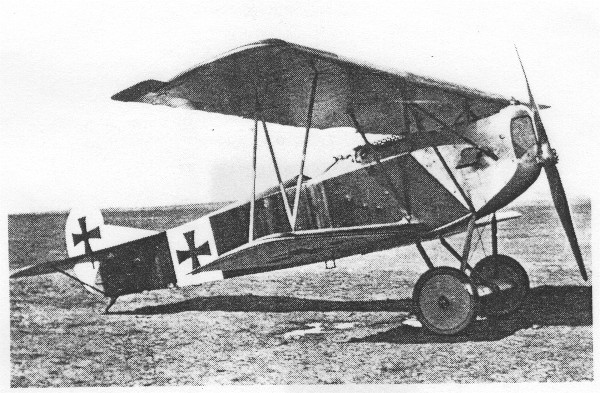
On this day the Jasta War Chronology states that 55 Squadron lost 4 DH4's D8356 , D8388, D8413 and F5714. D8356 was lost to Flak. The remaining 3 were shot down by members of 70 Jasta (Squadron) flying Fokker DV11s (see photograph below): Ltn A Stephen shot down one over Albersweiler, Vfw Lemke shot down one over Bergzabern, and Vfw T Krist shot down one over Brumath. (These locations are marked on the map below).'The DH4 file', which lists the fate of every DH4, reports D8356 as failing to return from a raid on the Kaiserslautern works; it does not mention Flak. It lists D8388 as failing to return from a raid on Kaiserlautern, believed hit by antiaircraft fire. D8413 is listed as failing to return from a photo recce, believed shot down by anti aircraft fire. The full entry for F5714 reads: powered by an Eagle VIII engine, delivered to 55 Squadron on 23/8/18, failed to return from a raid on the Kaiserlautern works, believed hit by AA 25/9/18. 2/Lt Dunlop and 2/Lt Heyes both POW (se below).
Saunders adds: Of the two books I would suggest that the Jasta War Chronology is the more accurate. This would mean that Lt A.C.Heyes was shot down by one of the three pilots and not by Anti Aircraft fire. I am sorry I cannot be any more specific than that. None of the German pilots mentioned became 'Aces' i.e. had more than 5 victories, so another source of cross reference is not available.
OK, so I cannot claim that Dad was shot down by a German Flying Ace; but one cannot have everything!
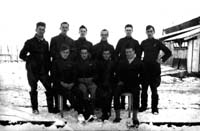 Arch remained in a German PoW camp for approximately six weeks until the war ended on
11th. November, 1918. In the photograph Arch is in the front row, second from the left;
notice the snow - Arch looks particularly cold. He was repatriated on
13th. December 1918.
Arch remained in a German PoW camp for approximately six weeks until the war ended on
11th. November, 1918. In the photograph Arch is in the front row, second from the left;
notice the snow - Arch looks particularly cold. He was repatriated on
13th. December 1918.
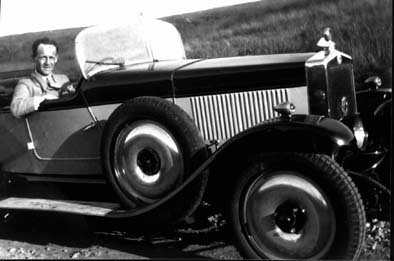 Between the wars Arch had a number of jobs, mainly in the motor trade.
At one time (1930) he was the Manager of Gordon Stuart's Motors
of Sale, Manchester.
He also spent some time working in Sierra Leone.
His time in Africa was cut short when he returned having contracted
Between the wars Arch had a number of jobs, mainly in the motor trade.
At one time (1930) he was the Manager of Gordon Stuart's Motors
of Sale, Manchester.
He also spent some time working in Sierra Leone.
His time in Africa was cut short when he returned having contracted