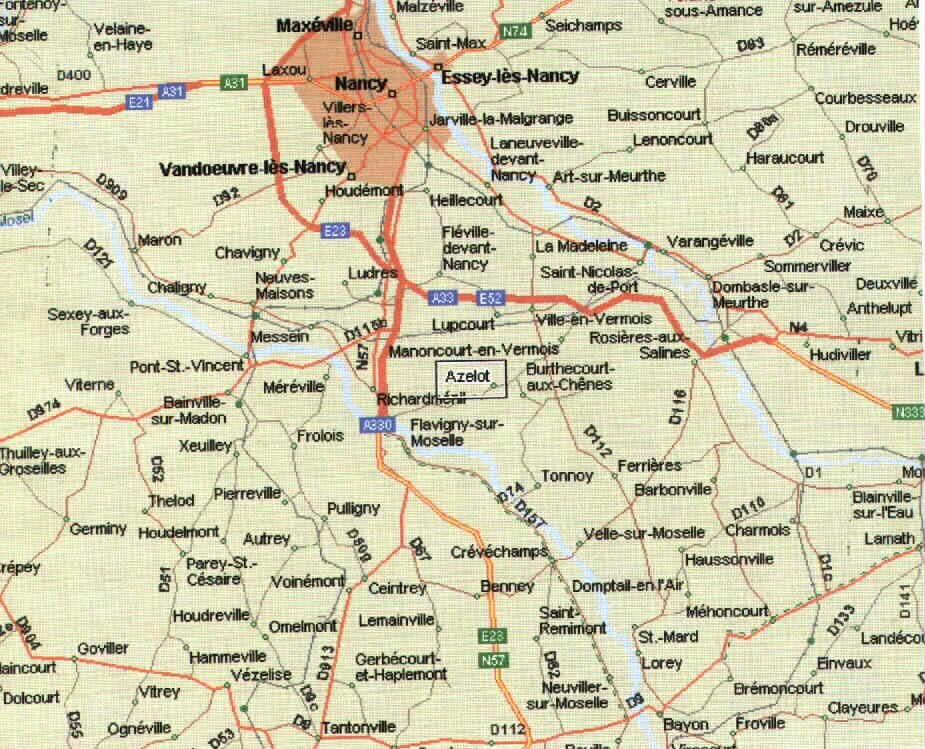
55 Squadron RAF in 1918
|
Mrs. Marvel M. Wagenaar-Wilm, President of the
International Biggles Association
was good enough to send me a these two articles. The first is written by
W.E.Johns, the second, about W.E.Johns.
Both give a colourful insight into
life with 55 Squadron during the summer of 1918.
|
|
There is some overlap between the two articles but both are well worth reading.
Jump to the second article
MEMORIES OF "55"
From: POPULAR FLYING, May, 1935.
by W. E. JOHNS
This has been written from memory, so spelling of names may be incorrect.
Dates are probably right, as they have been checked with log-book.
No. 55 Squadron was a bomber squadron, not a fighter Squadron, but that does
not mean that it did not fight. On the contrary, towards the end of 1918 it was engaged more than once in combats that might hold the record for
duration, if not for ferocity, although it should be said that nearly all
the actual shooting was done by the lads in the back seats. It is worth
noting, too, that different from clashes between single-seaters, there was
no question of breaking off a fight. We started, and whatever turned up, we
went on, with the E.A. hanging on to our flanks and rear. I cannot remember
a formation breaking up or turning back on account of E.A.; I don't think it
ever happened.
Memories! Curious thing, memory. With one or two exceptions, the things that stand out most clearly in my mind are not major operations as a whole, the details of which are more than half forgotten, but fleeting impressions of
incidents that occurred in a second of two of time, sometimes on the ground,
sometimes in the air. I can see those pictures just as clearly now as I saw
them then. Just why some things should focus so clearly and persist, while
others, really more outstanding, become blurred with the mists of time, is
hard to explain. Two regular scenes can never be forgotten: the dimly lit
dining-room at dawn, with the stars still in the sky, and silent heavily
clad figures of the fellows on the show drinking coffee round the tables,
and, the sing-song round the piano after dinner.
One of the most vivid pictures I see is a D.H.4 silhouetted against an
unbroken background of blue sky. It is flying level, quite close, perhaps
thirty feet away. From it, a long trail of jet black smoke swirls away aft
in a dead straight line. The pilot was a friend of mine; I had taught him to
fly. I was flying number 3 in the formation and he was flying 5. I looked
across at him, as I had done a hundred times, and saw the smoke. He was, at
that instant, unaware of the fate that had already claimed him, and was even
now overtaking his gunner. He saw me staring. I pointed. He looked. His nose
went down and he was gone. We were at twenty thousand. For half an hour or
more I could see the smoke trail to the ground.
The next picture is of an Albatros, nose down, so close that by reaching out
I could almost touch the yellow shark-shaped belly that was turned towards
me. Silly (* now Squadron-leader B.J. Silly, M.C., D.F.C., R.A.F.) got him.
He said afterwards that he thought the fellow was doing an altitude test. My
own opinion is that he was looking for us, but couldn't see the wood for
trees. I didn't see him until he was falling. We were homeward bound.
Fifteen E.A. came in over Boblingen, but we fought them off. Some more came
up S.E. of Strasbourg, but soon faded away after Atwood had got one of them.
For the moment all seemed clear. I had my eyes glued on Silly, who was
leading, for we were sitting desperately close. Suddenly, I saw his nose
creeping up. This was unusual, and I couldn't think what he was at. The
leading edge of my centre-section would have prevented me from seeing above,
even if I had looked, which I don't think I did. Then I saw his nose jerk
up; the tracer jumped for an instant, and then his nose came down again. He
had not moved five feet from his original position. Then I saw the Albatros
for the first time. It was about thirty feet in front and above us. I saw it
as it shot up over the leading edge of my top plane. As it went up it
turned, as if the pilot had dragged the stick back into his right thigh
without rudder. The movement held, became a tight, crazy loop, and then the
machine roared straight down on to us out of control. I knew it must hit one
of us -we were six- for we were too close together for it to go through -or
so it seemed. Everyone skidded, and the Albatros went straight through the
middle of the formation on its back. When I could get my breath I looked
down. It was spinning, and never came out. We were at nineteen thousand. I
didn't see the end, but the gunners said he crashed in a wood. I can still
see that gentleman falling on me.
The third incident is rather confused. We were bombing Stuttgart. I had a
target all to myself -the magneto works. The formation began to turn up-wind
to do the dirty work, but I had to go on for perhaps two miles. I never got
there. Half way the archie faded, and I looked round with my heart in my
mouth. Huns were falling out of the sky between me and the formation.
Slinging my two 112 pounders clear, I turned, and saw that I could never
reach the formation, which was now about three miles away and making for
home. Then, to my right, I saw our second formation just arriving. I went
for them like a drowning man making for the proverbial straw, but the Huns
cut across and stopped the gap. They floated in -maybe you know that funny
way they seemed to float, so lazily, with the props slowly turning the wrong
way. I didn't stop. I daren't. I can still see that scene; the E.A. all
round taking a crack at me as I went through them like a partridge along a
line of guns. I tailed on to our formation, and there I stayed until we got
home, when I was soundly cursed for my pains. But this is all wrong; let us
start at the beginning.
Fifty-five Squadron was formed at Castle Bromwich in April, 1916, and went
overseas with D.H.4's (Rolls Royce "Eagle VII's") in March, 1917. Shortly
afterwards the intensive German raids on London called for reprisals, and
the Independent Air Force was formed to hoist the Hun with his own petard.
General "Boom" Trenchard was given command and took three Squadrons (55, day
bomber; 100, F.E.2B night bombers, and No. 16 Naval Squadron) to Ochey.
Later 55 moved to Tantonville and Azelot, where with 99 and 104 Squadrons,
which joined the I.A.F. later, it served until the end of the War.
My own method of joining the squadron was most irregular, as I can claim to
have posted myself to it. This is how it happened. I was instructing at No.
2 School of Fighting, Marske, when one day the C.O. sent for me and told me
I was to proceed to France forthwith, reporting at the Air House for
instructions. I caught the next train, and was at the Hotel Cecil early the
next morning. There I was given a warrant and told to report to Lympne
forthwith, where I should find a D.H.4 ready to be taken over; but on
arriving there McKay, the C.O. told me he knew nothing about me or a D.H.4.
Nor did anyone else. I hung about Lympne for three days, but nobody knew
anything about anything. Life became boring, so I butted into a Canadian
poker school. Two hours later I got up from the table, not only broke, but
having distributed my next month's pay in I.O.U.'s. Which wasn't so good. A
that moment a queer looking cove with side-whiskers -I never did learn his
name- blew in and said, "Well, I'm just off." "Where?" said I. "France, in a
H. Pip," said he. "Wait a minute," I told him. I paid my mess bill with a
cheque I hoped Cox's would meet, but was afraid they wouldn't, fetched my
valise, threw it into the Handley and crawled into the front seat. Was it
cold? It certainly was. That trip taught me never to fly in an open cockpit
machine without a coat on. We had a drink at Marquise, which I discovered
was our destination. I tried to get a little money from the field cashier,
but there was nothing doing, so there seemed no point in staying. I saw the
same H.P. that had flown me over being started up. I ran across and found a
delivery pilot about to take the machine on to Bourget. Did I want to go to
Paris? I did. There was already a fellow in the forward seat, and one in the
second pilot's seat, so I climbed into the carcase. There was nothing to sit
on except the floor, so I sat on it, with my legs hanging through the bomb
holes.
We had been in the air about five minutes when the main tank burst. A geyser
hit me in the back, and soaked me through. Luckily I had just tapped my pipe
out through the hole in the floor. The pilot was evidently still flying on
gravity, for he went on as if nothing had happened, and to get to him I had
to force my way through the bomb-racks, pushing them on each side into the
shape of a dog's hind legs. We went back to Marquise, got another machine
and went on to Paris. Arriving, I dumped my valise in the mess and tried to
get some money, but there was still nothing doing. My pilot had a car going
into Paris and offered to show me the sights. We parked our stuff at an
hotel and then went to the Folies, where I lost him. I came out about one in
the morning and remembered I had forgotten to ask him the name of the hotel.
I had never been to Paris before and it all looked alike to me. I cruised
about a bit in a taxi, calling at hotels to see if I was staying there, but
finally I had to make the driver take me to Bourget in order to get the
money to pay him. I never saw my pilot again.
Early in September the American First Army marched across the aerodrome into
the St. Mihiel Salient. When they halted officers used to come into the mess
for a drink, and they talked of the War as if it was a joke, referring to
the line as the "shooting gallery," and so on. They were "going to show us,
and the Frogs." I got fed up with this one day, and started saying
something, but Jock McKay said, "Shut up, the poor B's don't know what
they're talking about." And that was just about the truth of it. They knew
in a day or two, though. We supported their show by bombing back areas. By
midday it looked as if the U.S. lads had made about nine kilos, but by
nightfall they were back pretty well where they started from, having
suffered terrible losses. Poor beggars; how could they know what the War was
like? Two or three American pilots joined us about this time, and I must say
they were very good chaps, quiet and unassuming, quite different from the
article that is presented in fiction. About this time, too, I had a nasty
experience. Coxhill, who usually flew with me, went sick, so I took a new
lad from some observers who had just come up. I told him what to expect and
what to do when it happened. The show was Stuttgart, with Silly leading. We
started with twelve machines, but only nine got to the objective. We bombed
the Daimler works, and were on our way home when fifteen E.A. intercepted
us. One decided that I was his particular meat, and came close enough under
my tail to make shivers run down my spine. I wagged my tail gently to give
my gunner a clear view of him. His gun fired one shot, and that was all.
Then he disappeared from sight. I had no doubt that he had been hit, and had
a miserable quarter of an hour with the E.A. making nice shooting at me.
Then two of our fellows - Miller was one, I think - seeing what was going
on, closed in on each side and let him have it, which discouraged him
somewhat. (I believe it was Miller's machine that we once counted 114 bullet
holes, after a show.) When I landed I raced tail up to the ambulance,
thinking my lad might have a spark of life left in him. (In the D.H.4 it was
impossible for the pilot to see into the back seat.) I switched off and
turned round, and there he stood as large as life, but a trifle pale withal.
My sympathy quickly gave way to marked displeasure, and I asked him in a few
well-chosen words why he thought I cluttered my machine up with him. He said
his gun had jammed. Before I could answer, the gunnery officer ran up, and,
hearing what was going on, picked up the gun, gave it a shake, pointed the
muzzle to the ground, and pulled the trigger. Away she went, as right as
rain. About half an hour afterwards I was lying on my bed wondering if I
ought to report the matter when the lad himself blew into my room, and after
admitting that he had had the wind up, asked me to give him another chance
the next day. I did. I couldn't do anything else. And I am glad to say that
he stood up and fought like a good 'un. But it was a bad show and he was
killed. He had only been in France two days. That was the luck of it.
THE END
This article is "Copyright by W E Johns (Publications) Ltd" it has been
reproduced in this context by the kind permission of the copyright holders.
Further reproduction may not take place without their authorisation,
for which application should be made to
Linda Shaughnessy, A P Watt Ltd.,
20 John Street
London, WC1N 2DR
Tel: +44 20 7282 3120
Fax: +44 20 7831 2154
(direct e-mail: lshaughnessy@apwatt.co.uk)
Jump to the first article
Another article on WEJ and 55 Squadron by
Mike Armstrong published in
Cross & Cockade, vol. 24, no. 4, 1993
The First World War Aviation Historical Society.
55 Squadron RAF - The Johns Connection
by Mike Armstrong
The RAF squadron which 2/Lt William Earl Johns entered at about the end
of July was No 55, a day bombing unit equipped with Rolls-Royce engined De
Havilland 4 biplanes. It was stationed at the new base at Azelot, a village
a few miles south of Nancy in the southern region of the Western Front.
This base they shared with two DH9 equipped squadrons, 99 and 104; all were
part of Maj General Sir Hugh Trenchard's 'Independent Force', and all had
the dangerous duty of carrying the air war over the frontiers of Germany
proper to attack her war industries and transport systems. This facet of
Allied strategy had been launched the previous autumn, impelled by the
strong 'hit back' feelings of the British people after an ill-defended
London had been severely bombed by German aircraft.
55 Squadron had been relocated from its previous Flanders base at
Boisdinghem. Now, at Azelot, its orders were more daunting; most of the
names on its list of targets were anything from 70 to 170 miles from base.
From a 1993 standpoint these mileages look trivial, but in 1918 they meant a
mission of perhaps five hours flying time. During this they could be locked
into very long running fights with defending German fighters whose numbers
were now increasing rapidly.
Johns, years later, blossomed into a finely gifted aviation writer and, of
course, in this article about his own time in the squadron we shall bring in
some of the superb passages he penned about it.
So, direct from WEJ we have this, "No 55 Squadron was a bomber squadron, not
a fighter squadron, but that did not mean that it did not fight. On the
contrary, towards the end of 1918 it was engaged more than once in combats
that might hold the record for duration, if not for ferocity... " WEJ writes
several times of the great distances over the lines which the squadron
reached when it had to fight. Perhaps he was making a deliberate comparison
with the better known lot of the fighter pilots when, in his fictional The
Rescue Flight he has Biggles observing to a novice Camel pilot "Few people,
even old hands, care to go more than ten miles over."
Prior to Johns' arrival, the unit had reached Cologne, Coblenz, Mannheim,
Landau, Oberndorf and Rottweil, all over 100 miles from home, as well as a
lot of less distant targets. The hilly and varied terrain of the
French-German border areas - still pleasantly rural and not devastated by
war - seemed to attract very mixed weather, much of it unreliable for long
distance flying: but 55 Sqn was run by very determined men, who made use of
every favourable day. More of these men later.
Johns' own account of 'how he posted himself to 55 Sqn' originally appeared
in Popular Flying magazine in the 1930s. This is pure comedy and no
following author can succeed, using his own words, in bettering the effect.
Briefly, Johns arrived at Lympne in Kent with orders to pick up a DH4 for
ferrying to France. No DH4, nor his papers, appeared. Having hung about to
no avail for three days, playing financially disastrous games of poker, he
accepted, on impulse, a lift in a Handley-Page to cross the Channel. This
began a succession of aerial lifts that - motivated by an earnest desire to
find the Pilots' Pool at St Omer - he freely accepted, but which involved
him in nocturnal adventures in Paris, two crashes, and the steady loss of his
money and kit. Finally, in this deprived state, he arrived in front of Major
Alex Gray MC, CO of 55 Sqn at Azelot - 250 miles from St Omer. Gray, a Scot
given to brief and to-the-point speech, said "Ah. I have just lost five
machines. I can do with some DH4 pilots". It occurred to Johns that perhaps
he had taken the wrong turning.
Gray perhaps had in mind the 20 July raid on Oberndorf, 110 miles from base,
when nine aggressive EA had 'jumped' the DH4s near the objective. As a
result of a long engagement on the way home Young, Butler, Nash, Baker,
Pollack and Keep would no longer take their places in the squadron messes;
four killed, one wounded and one prisoner. Johns, in the next few weeks,
would see a lot of this.
Azelot was a rapidly developing complex of hangars, workshops, and personnel
camps, with nearby Archie defences, plus two French airfields of Manoncourt
and Burthecourt within two or three miles. 55's officers' camp was in a
pleasant orchard, pictured in several shots in Journal Vol 22, No 2. Johns
wrote with feeling of this... "A white dusty road, with little mirabelle
trees rambling along the sides... fat, shuffling figures in great clumsy
boots... the smell of sheepskin... engines idling, tickeratock, tickeratock,
like reapers hurrying in a cornfield... " Thus the airmen of 55 went to war.
Johns' flight commanders were a tough and seasoned lot. Capt D.R.G. Mackay
(Jock), Capt B.J. Silly MC, Capt Frederick Williams MC, and Capt J.R. Bell
together had a
wealth of knowledge of penetrating the expanding German defensive network.
Mackay was the son of a Scot in the Indian Civil Service; Silly was English,
a product of Tonbridge School; Williams, only twenty, was Australian born;
and Bell, a rather dark, morose man, had been an officer in the Dorset
Regiment.
Among the pilots and observers were brave and capable men, many of whose
names Johns has highlighted in his writings and who were to notch up 30 or
40 raids with 55 Sqn, men of whom Alex Gray was to write, years later, "They
were all like that. I didn't have to 'run' the squadron, it ran itself".
S.L. Dowswell (pilot), J.R. Pace (pilot), E.R. Stewart (observer) and D. W.
Stewart (observer) were Canadians; other stalwarts were H.S.P. Walmsley,
W.R. Patey, C.A. Bridgland, J. Cunliffe and R.P. Ward. C.L. (Pip) Rayment,
like Johns, came from Hertford. H.C.T. Gompertz, an observer, aged 20, was a
great character; he had, not long before, been an outstanding student at
Winchester College, but now was on his way to be 55's 'ace' with a final
score of 5 kills and 2 driven down. Johns' logbook is not available to the
authors of these articles, nor any record of his unscheduled advent at No
55. His official taken on strength date was not until 21 August and, as will
be seen, his first recorded operation date, 2 September. This apparently
long time scale might be explained by a need to first establish his
credentials, via sources in the UK, and to give him a thorough training in
the quite difficult close formation flying that was so vital in 55's
daylight operations. Periods of poor weather may have hindered this. Also,
he spent a period in the hospital in late August. He wrote that he made 23
flights in the war area. Johns' arrival at Azelot may have coincided with
the period of generally unfavourable weather between 23 July and 7 August,
but 55 made good use of a break in this from 30 July to 1 August, with long
distance raids on each day. The first, to the Offenburg railways, 80 miles
distant, was led by 'Billy' Williams and involved a great battle against
fifteen EA on the homeward leg. Earle Stewart, the young Canadian, drove one
down out of control. Two DH4 observers, Beesley and Barker, were wounded.
Next day Capt Silly made one of the squadron's many attempts to reach
Cologne (Williams had succeeded once, in May 1918) but had to settle for
Coblenz due to excessive cloud formations. This was an example of a daylight
raid where choices of target, and of routes out and back, were cleverly made
by an experienced leader who took his men and machines over the whole course
without loss. Much the same applied to the 1 August operation - another
attempt on Cologne led by Williams. Düren was the victim instead, and one of
55's most distant at 155 miles.
There was no combat on the 8th when operations resumed with Silly getting
eleven machines to Rombach in a hazy, cloudy, atmosphere.
The enemy were more successful on the 11th however, when Bell and Mackay led
two formations towards Mannheim. Near Saarburg, nine fighters piled in and
Bell's petrol tank was holed; because of escaping vapour, he dared not fire
the usual green 'washout' Very light so, when he turned for home, two others
followed. Mackay attempted to gather the remaining ones into his own flight,
but all were now too scattered, so he led everyone home with the bombs still
on. Bell's men got nowhere near Mannheim and bombed the new fighter
aerodrome at Buhl. Survival, when over hostile territory for long periods at
a time was, Johns wrote later, a matter of close and strict formation
flying. "Discipline... is essential". "The formation sits pat, as tight as
possible... leaving the shooting to the gunners". "Once a pilot loses his
position, the hostile aircraft will concentrate on him like a cloud of
wasps" "... I have sat still for three hours or more, eyes glued on my
leader for any signal he might make... " "Don't look at the ground; you are
so high up that you do not appear to be moving". "It is fascinating to watch
the gunner in the machine on your right, pumping out lead or working like
the dickens to repair a jam." "Tactics, in a true sense of the word, hardly
enter into it". And, most tellingly; "In long-distance operations a scout
escort is impossible, so the lives of the bomber pilots are therefore in
their own hands or in the hands of their leader."
In these conditions, the sudden loss of a comrade who had been flying
alongside was a uniquely cruel shock "...a DH4 silhouetted against an
unbroken background of blue sky. It is flying level, quite close, perhaps
thirty feet away. From it, a long trail of jet black smoke swirls away aft
in a dead straight line. The pilot was a friend of mine; I had a taught him
to fly. I was flying number 3 in the formation and he was flying 5. I looked
across at him, as I had done a hundred times, and saw the smoke. He was, in
that instant, unaware of the fate that had already claimed him, and was even
now overtaking his gunner. He saw me staring. I pointed. He looked. His nose
went down and he was gone. We were at twenty thousand. For half an hour or
more I could see the smoke trail to the ground."
The two formation failures of the 11 August raids may well have irked Major
Gray and the occasion may have moved Johns to write "The CO told me...
things in a short crisp lecture, and during the following month they were
tattooed on my memory with Spandau bullets".
12 August saw Silly and Mackay lead a successful long raid to Frankfurt with
twelve DH4s. The objective was reached in the face of attacks by enemy
fighters both en route and on the return, at least 35 being present at one
time. 2/Lt Clutsom and Patey each got a 'flamer' and Gompertz and Sgt Allen
each an 'out of control'. But Earle Stewart, popular in the squadron - and
so young at 18 but a veteran of over 40 operations - received fatal wounds.
This was perhaps 55's most impressive performance ever, when against odds.
Here we must touch on the elusive nature of some of Johns' written
recollections. He wrote of this raid, "I was on that show and it was one to
be remembered, believe me". Records do not reveal him as a participant,
although he may have been a reserve pilot.
Elusive too is the source of his vividly-written account of the other kind
of mission flown by 55 at that time - the photo-reconnaissance well beyond
the lines, which was done on all fine days and for which the fast
high-flying DH4 was so finely suited. In The Day's Work, written in about
1932, Johns describes a photographic tour of German aerodromes "37, 11, 46,
78" with take-off at 5.15am and return at 9.55. Several German fighters were
engaged or evaded; with maximum altitude and speed capabilities of 21000ft
and 136mph, the 'Four' could look after itself with a competent crew. And
Johns' word-picture of the panorama, as he reached his en-route altitude, is
memorable.
"Below me the hangars of the aerodrome I had just left nestled cosily beside
the village ... little summer clouds, pink-flecked, and soon to be dispersed
by the rising sun, floated by me, and to my far right glittered the icy
minarets of the Swiss Alps".
No reconnaissances by Johns are mentioned in the Squadron History; but other
records could exist which would pinpoint the one he describes so vividly.
The summer weather was now involving the squadron in a sequence of raids,
most of them fiercely contested by German pilots. August 1918 was to be a
focus for any historical account of the early days of the unit. On the 13th,
Buhl aerodrome was attacked in place of Mannheim; six EA contested passage,
one becoming a flamer and one out of control. But Sgt S.E. Lewis was killed.
The 14th saw yet another try for Cologne, or Coblenz, with Mackay as leader.
He had to settle for Offenburg, itself a distant objective. Along the way
home, about 30 EA arrived. Two of these were destroyed and two driven down
out of control by the observers. A little light relief was afforded after
2/Lt Dunn's machine received damage to its cooling system and the pilot had
to 'dump' it in a field at La Matacuelle, just inside the French lines. The
German victor, not recognising this, landed alongside to claim his prisoner,
but ran into a hedge and broke his ribs. "He was taken prisoner, and was so
sick with himself that he refused to eat, drink or speak. I expect he has by
now though" quipped Johns in 1935.
The raid on the 16th was very hard. Ten machines reached Darmstadt, 140
miles from base. In flight, Silly made a change of course for Mannheim owing
to thick cloud, but reverted to the original target when it became evident
that the en-route speed - around 90 mph with the loaded DH4 - was
satisfactory. The enemy was almost ever-present; first 'several' then
'fifteen'; then, when well on the way to home, at Saverne, a notorious
trouble-spot, some eight really skilful enemy pilots attacked and brought
down three DH4s. Five crew were killed and one made PoW, and two observers
wounded and one injured when a further DH4 was forced to land on the home
side. An expensive raid for '55' - and not for the last time. Fortunately,
poor weather allowed the squadron to ease off during the next days, with
just the solo reconnaissance efforts continuing. Bombing resumed on the 22nd
and 23rd, which meant more endeavours to get to Cologne. Cloud and wind
again stopped these. Bell had to settle for Coblenz on the 22nd, but
thankfully there were no combats. The next day Treves (now Trier) (85
miles), the alternative, was bombed. Five EA came in near Conflans, but it
was a lack-lustre effort.
24, 25, 26 and 27 August again brought weather that was not much use to the
squadron, but they did raids, nevertheless, on the second and fourth of
these days. On the 25th, Lt W.J. Pace led a small group, fragmented by
engine problems to Morhange aerodrome, while Bell, never favoured to reach
Cologne, reached Luxembourg instead. 2/Lt J.A. Lee and Sgt A.S. Allan,
observer lost their lives at the hands of 15 attacking EA. On the 27th,
Mackay got no further than Conflans. 30 August was another grim day for 55
Squadron, Bell again had the task of reaching Cologne. Thionville was as far
as he got, while Lt E.J. Whyte bombed Conflans. Johns' account (1935)
tallies well with the records, and, of course, has tremendous colour. "The
previous evening I was one of a poker school of six. By lunch time the next
day I was the only survivor, and that because I wasn't on the show. Bell
took a formation of six machines over and came back alone after fighting
twenty-seven EA for the best part of an hour. Dowswell brought his machine
back over the lines, but force-landed at Pont St Vincent. Gompertz was his
gunner. He got two EA, but what a mess he was in when the tender brought him
home! This was due to the fact that Dowswell had an aileron shot off and
could only fly dead straight. Gompertz's Sidcot hung on him in ribbons; it
had literally been shot off his back... one bullet only hit him - in the
shoulder. He didn't seem in the least upset. He just sat in the door of his
hut, with the rags still hanging on him, and laughed."
When Bell climbed from his solitary and shattered DH4 back at Azelot, he
faced Major Gray. It was a grim exchange between two 'men of few words'.
"Where are the others?"
"They are all gone."
Bell had a bullet score across the top of his flying helmet. The little top
button had vanished. Whyte's formation had also been fighting, and had
downed one of the nine fighters that had attacked. 55 Squadron's casualty
list had eleven names on this day. R.A. Hickes, T.H. Laing, T.F.L. Myring
and C.E. Thorpe, KIA; P.J. Cunningham and J.C. Quinton KIC; A.J.C. Gormley,
A.S. Papworth, H.H. Doehler (US) and W. W. Tanney (US) PoW: and H.C.T.
Gompertz, WIA, who, after treatment, returned to the squadron to continue
his energetic career as an observer.
At about 9pm the same evening, 'Fritz' was continuing his torment. A
parachute flare heralded a well aimed line of bombs which fell near 55's and
104's camps and on the
'Archie' battery on the slope west of Azelot village. "I remember seeing the
corrugated-iron latrines take flight" wrote Johns. "One bomb fell right
beside the Mess... luckily it was a dud. The next morning somebody - Don
Waterous, I believe - dug it out and unloaded it. Some fool put a match to
the explosive to see what would happen. It didn't explode, but it caught
fire, and you couldn't see a yard for black smoke. It poured into the dining
room where the CO was having his breakfast; he came cursing."
We are seeing how the men of 55 Squadron - and their brother squadrons -
were subjected to a test to destruction on each operation they flew. There
had to be compensations. The explosives incident was one. Riotous nights out
in Nancy were another. Johns describes the scene in the Liegeois restaurant.
"The Liegeois, in Nancy, presented a gay spectacle in the roaring days of
1918. Tenders from 55, 99 and 104 day bomber squadrons and 100 and 216 night
bomber squadrons disgorged their enthusiastic cargoes to mingle with dapper
and bemedalled French officers, 'pilots de chasse' as they loved to call
themselves. Their long CdeG ribbons, sometimes over a foot long, festooned
with bananas, each bunch representing a vanquished enemy, interested us
immensely... In and around this happy throng fluttered ladies of
considerable charm and persuasion. Change the uniforms into sombreros and
chaps and it might have been a cowboy saloon of the last century."
"Everyone was happy. The proprietor would cash cheques for any reasonable
amount, and Cox's was far away" "A meal was a boisterous affair. Officers
announced their arrival in diverse fashions. One (I wonder what he would say
now if he saw a junior officer do it) usually teed up a wine glass on the
counter and drove it down the room with his cane. The damage was always paid
for, so what did it matter? We had to have a safety valve somewhere. If,
during the daily trip through hell and back, we earned our pay, then we
spent it royally at night."
So August 1918 ended. German defence activity had increased dangerously, but
55 Squadron had not reduced its aspirations.
The first week or so of September brought cloudy conditions, and other
circumstances, which caused the operations to be mainly short range. 'Other
circumstances' on 2nd consisted of two all-out daylight attacks on the
fighter airfield at Buhl by all three De Havilland squadrons - 55, 99 and
104. There was a morning and afternoon armada. Mackay led 55's contribution;
Johns, with his usual observer, F.N. Coxhill, flew No 4. Both forays
resulted in damage, though not heavy at Buhl; the airship shed was hit. In
both operations, Johns experienced a heart-stopping incident. In the first,
Waterous, flying immediately over Johns, allowed his wheels to momentarily
nudge Johns' top plane, but without damage or loss of position to either
machine. And, on leaving Buhl on the afternoon show, Johns realised with
horror that one of his 112lb bombs was still wedged in its rack. His vow
that his landing at Azelot was going to be a featherbed one was ruined by an
upcurrent he encountered as he let down over 99's hangars. The landing was
heavy and the bomb hurtled away over the grass - but didn't explode.
On the 4th, Buhl was attacked again by Bell; but only because a high wind
prevented his reaching Karlsruhe. More days of useless weather followed,
until on the 7th, Mackay, with six machines, tried for Cologne, but settled
for the railway junction at Ehrang. During this time, the squadron had, of
course, done its job in the photo-reconnaissance department. Points reached
had included Strasbourg, Karlsruhe, the Seer Valley and the ever-developing
defence airfields. 55 Squadron's reconnaissance specialist, Frederick
Williams, MC, DFC, who flew 17 such shows, had returned to the UK in mid
August. The high and fast 'Four' normally evaded the fighters but, on 7
September, Waterous and Rayment only just escaped from seven of them which
attacked near Saarburg, and then tailed them back over the lines. Fokker
DVIIs were among them - still a relatively new type in the IAF area. There
were now rumours of newer and more potent German types, such as the Siemens
Schuckert DIV with its fine high altitude performance. During Johns' time in
the squadron so far about twenty-five photographic shows had been done
without loss. On a misty 6 September, at about mid-day, the RAF at Azelot
were alerted by the racket of fire from their local Archie battery. A German
Hanoveraner two-seater was circling the field at very low altitude. Rounds
from the Lewis guns in the ground pits arced up, but soon ceased when four
SPADS were seen rising rapidly from the adjoining French field. These
hunters, and the hunted, dodged in and out of drifting clouds. The leading
SPAD made a headlong dive on to the Hanover's tail but then seemed to thread
itself on to a stream of fire from the observer, and it crashed violently
beyond the aerodrome boundary. The pilot had been shot through the head. The
other SPADS chased the German ten miles south where they disabled its engine
and forced it down; the German pilot had mistaken the field for a friendly
one. The French later exhibited the machine in Stanislas Square, Nancy.
About this time, some nocturnal watchers spotted a car driving at high
speed, headlights blazing, along an old track that ran across the airfield;
this had been immediately followed by German air activity overhead. The next
night a number of armed enthusiasts lay in wait in case the car should
reappear - which it did. Amid a lot of frenzied yelling and the row of a
Lewis gun turned on to it, it raced off unscathed. It never reappeared.
By now, the American First Army's large-scale offensive against the St
Mihiel Salient (about 40 miles from Azelot) was imminent and the Independent
Force squadrons were required to contribute by reconnaissances and the
bombing of the enemy back area railway junctions and the defence aerodromes.
The lead-in period and the first two days of the offensive, which began on
12 September were marked by a heavy rain and atrocious visibility which made
daylight forays all but impossible. Instead of the 13000 to 20000 feet
altitudes at which they could so ably practice their skills, they were
forced to fly at 2000 feet or lower, and so, in cloud, this brought the
great dangers of collision with friendly aircraft or with the many hills in
the district, and even attacking the wrong targets. 99 Squadron,
particularly, suffered from this. 55 Squadron carried out these difficult
reconnaissances on 8, 9, and 14 September, crews being Welcuman/ Patey,
Welcuman/Clere, Pace/Barlow, Dowswell/Howard and Waterous/Patey. There were
no aerial combats or mishaps. On the last of these days, Mackay took twelve
machines to bomb the railways at Ehrang, using mainly the heavier 230lb
bomb, with success. Johns, with 2/Lt A.E. Amey as observer was on the show.
On the morning of 15 September the squadron was able to recommence the long
distance operating. Nine machines, with Silly leading, reached Stuttgart at
09.40am. Johns was there, in Silly's formation (the other was Pace's) and he
had the individual responsibility of dropping his two 112lb bombs on the
Bosch magneto works, two miles further on than the main target. He didn't
quite reach it for, at the critical moment he saw several EA diving into the
space between his machine and the others.
"They floated in", he wrote. "Maybe you know that funny way they seemed to
float, so lazily, with the props slowly turning the wrong way... I went
though them like a partridge along a line of guns".
On the way home, fifteen fighters tried to climb up out of Boblingen to
attack - several others came up south-east of Strasbourg and made an
engagement. Atwood shot one down into a wood, while Silly himself got
another with his front gun (his reactions must have been rapid indeed,
chance with the front gun was rare in these combats). This victim then
roared up in a climb, fell over in an uncontrolled dive and went straight
down through Silly's formation, where the pilots skidded wildly in all
directions. But all of the formation landed safely at Azelot.
|
|
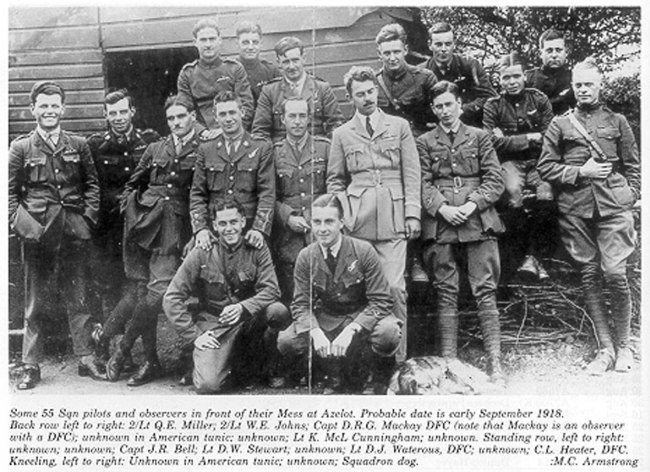 Johns is second from the left on the back row.
It is tempting to believe that my father is the Observer on the front row next to the Squadron dog but no, I think not.
|
|
The next day 16 September, brought a raid on Mannheim. In DH4 F5712, Johns,
with Amey, who came from Wimbledon, was on the show and it was to be their
last. After take-off at 12.20hr, Mackay's six machines got their height.
They crossed the lines at Raon L'Etape but Capt Fox's accompanying six
failed to formate, and returned to base. Five of Mackay's reached Mannheim
OK. But not Johns and Amey. Just past Saverne (that consistently unlucky
spot) a stray fragment from a desultory Archie burst punctured their main
fuel tank and his cockpit was soon awash, and the rear of the aeroplane
splashed with petrol. Amey riskily, fired the green Very light to inform
Mackay that they had to leave the formation. Johns had already seen a number
of Fokker DVIIs trailing him and rapidly climbing. He now found his reserve
fuel tank empty, all he could do was to jettison his two bombs, set his
compensator control for maximum economy, and start a run for home, sixty
miles away. All too soon the Fokkers were on him and Amey was in action with
his gun. Then Johns was grazed by bullets, his cockpit was shattered, and
Amey collapsed, fatally wounded. Johns tried tearing round in a vertical
bank, but of course had to break out in a bolt for home. As the pursuing
Fokkers put in more crippling bursts of fire he tried to handle the big DH4
like a fighter, skidding and weaving. Finally his engine went dead and he
sideslipped away most of his 6000ft to obviate an engine fire. Through
blooded eyes he could scarcely discern the approaching ground and, anyway,
the joystick now waggled loose. The movement of the machine in the air
became a series of huge hops uncontrolled by him. Fortuitously the machine
crashed with its nose slightly up and Johns' life was saved. Amey was dead.
Whilst Johns had been attempting to escape the Fokkers, he had seen in the
distance a lone British DH9 (or so he thought) fighting a losing battle very
similar to his own. This machine went down in flames. It is possible that
this was really a 110 Sqn DH9a, crewed by two sergeants, A. Haigh and J.
West, also on a Mannheim raid. So Johns ended his time with 55 Squadron and
went into captivity. That certainly began unpleasantly. He had the
misfortune to crash near the village of Ettendorf - between Saverne and
Haguenau, where British bombs had caused some havoc among civilians not so
long before. His captors locked him in a room in Ettendorf schoolhouse and
Amey's body was dumped on the floor with him for him to contemplate. His
adventures as a PoW - including two escape attempts - are not part of this
account. It is sufficient to say that he was given medical treatment and
then a series of clever interrogations of the usual type faced by Allied
PoWs. Johns gave nothing away. Then came a transfer to Strasbourg prison,
then Karlsruhe, then Landshut and, finally, the 'severe' camp known as 'Fort
Ten' near Ingolstadt. When the Armistice finally changed all this, Johns
joined a convoy of officers who were taken, via Strasbourg, to the lines
near Nancy. Defriefing, then a very rough channel crossing on 23 December
brought him to Blighty's shores. "After crossing the Channel in a terrific
gale, I arrived home [Little Dunham, near Swaffham, Norfolk] on Christmas
day causing a small sensation, for although I did not know it, I had simply
been reported 'missing' and given up for dead. When I walked in at the back
door dressed in odd bits of French uniform, the parlour maid who first saw
me let out a yell, dropped the saucepan of potatoes she was just lifting off
the range, and flopped down in a faint. I must have looked an odd sort of
ghost, if that's what she took me for. Anyway, having been nearly starved to
death for months, I certainly tucked away some pudding that day."
Our story of WEJ in 55 Squadron ends there. We have not attempted to report
or assess the 'business' aspects of this effective bomber squadron, such as
the weight of bombs dropped or damage done to targets; or even to write of
just who were their opponents in the air. Our story is about a group of
young men from all over the English-speaking world, and of how they fared
during this hazardous time.
In this, the year of the disbandment of 55 Squadron, we have looked at the
few weeks in 1918, centred on August, that were probably this fine
squadron's finest hour.
And W.E. Johns was there.
And so was my
Dad.
Except for the very last line......
This article is "Copyright by W E Johns (Publications) Ltd" it has been
reproduced in this context by the kind permission of the copyright holders.
Further reproduction may not take place without their authorisation,
for which application should be made to
Linda Shaughnessy, A P Watt Ltd.,
20 John Street
London, WC1N 2DR
Tel: +44 20 7282 3120
Fax: +44 20 7831 2154
(direct e-mail: lshaughnessy@apwatt.co.uk)
Post Script:
Andy Kemp of Cross and Cockade wrote to me:
You may be interested to learn that Mike is still going strong, and is an
avid researcher into the Independent Force, of which 55 Sqn was a part.
Strictly speaking the IF was a parallel organisation to the RAF, and didn't
fall into its command chain. I visited Azelot myself a few years ago, when I
was down in that part of France. It's a very atmospheric place - and there's
still an active flying & parachuting club using the site. You can easily
imagine the DH9 and DH4 aircraft taking off and landing - and there are
still a number of old buildings around the place. I don't know if any of
them are original to the period or not, but Mike may know.
My attempts to contact Mike Armstrong have failed - so far!
Further reading:
Two references - essentially the same book - recommended to me, but which I have yet to track down:
1) By Jove! Biggles!
The life of Captain W.E. Johns
by Peter Berresford Ellis and Piers Williams (a.k.a. Jennifer Schofield)
1981 WH Allen, hardcover (contains an extensive biography on Capt. WEJ.)
1985 Comet Books (paperback, without bibliography)
2) Biggles! The life story of Captain W.E. Johns
(extra chapter on WEJ's Centenary added and photos- all mistakes kept!!)
1993 Veloce Publishing Plc.
And web pages which draws on both British and German archive material to
obtain a detailed analysis of
W.E.John's last mission. (There are interesting discrepancies between
these formal accounts and the accounts given above.)
And a pictorial visit to the very places where the action happened.by
Eddy van Driel.
3) Lots more about Johns and a complete book list may be found at
www.wejohns.com
Jump to the top of the page